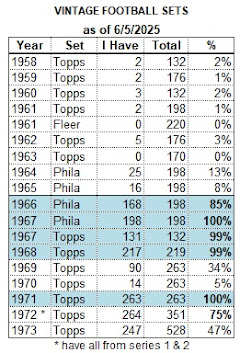
Here are the 1971 Cardinals. They sure have a lot of all-stars for a team that finished 8-5-1, but I guess that record was a real accomplishment for a team that finished 4-9-1 in every other season between 1969 and 1973.
Jim Hart was an undrafted free agent signed by the Cardinals in 1966. After riding the bench behind veteran Charley Johnson as a rookie, Hart was the starting QB for the next 15 years (except for 1969, when Johnson regained the starting job, and in 1972, when Hart and two others shared the starting assignments.) Hart was the backup behind Neil Lomax in '82 and '83, then finished his career with the Redskins in 1984. He was a 4-time Pro-Bowler (1974-77).
MacArthur Lane was the Cardinals' #1 pick in 1968. After riding the bench as a rookie, he returned kicks in 1969, then became the featured back for the '70 and '71 seasons, leading the NFL with 11 rushing TDs in 1970 while making his only Pro Bowl.
After the '71 season, he was traded to Green Bay for running back Donny Anderson, and was the Packers' top back for 3 seasons. Lane moved on to the Chiefs, where he played his final 4 seasons (1975-78). He was the starter only in 1976, leading the NFL with 66 receptions that season.
Johnny Roland was a 4th-round pick in 1965, but didn't play until 1966. He was a starting back for the Cardinals from 1966-71, and made the Pro Bowl in his first 2 seasons. Roland's final season (1973) was spent as the Giants' starting fullback.
A 10th-round pick in 1963, Jackie Smith was the Cardinals' starting tight end for 13 seasons (1963-75). He was also the team's punter for 3 seasons (1964-66), and made the Pro Bowl for 5 consecutive seasons (1966-70). After 2 seasons as a backup, Smith finished his career in 1978 with the Cowboys, appearing in Super Bowl XIII against the Steelers.
Ernie McMillan was drafted by the Cardinals in the 13th round in 1961, and also by the Boston Patriots in the 29th round of the AFL draft. He was the Cardinals' starting right tackle from 1961-73, then moved to the left side in 1974. Ernie was the Packers starting left tackle in his final season (1975). McMillan made 4 Pro Bowls while with the Cardinals.
Jim Bakken was drafted in 1963, and spent his entire 17-year career with the Cardinals. He made the Pro Bowl 4 times ('65, '67, '75, '76), led the NFL in field goal percentage in '65 and '67, and led the NFL with 117 points in 1967. Jim was also the team's punter in '65 and '66 (and briefly in later year).
Larry Stallings was the Cardinals' 18th-round pick in 1963, but parlayed that into a 14-year career, every one of them as the Cardinals' starting left linebacker. Stallings ran back a fumble for a TD in both 1965 and 1969, and made the Pro Bowl in 1970.
Roger Wehrli was the Cardinals' #1 pick in the 1969 draft, and spent the next 13 seasons as a starting defensive back for the Cards. Usually the right cornerback, he played left corner as a rookie, and strong safety in 1972. Wehrli made the Pro Bowl 7 times during those 13 seasons. He was a backup DB in his final season (1982).
Miller Farr began his career in 1965 as the Broncos' strong safety. He played for the Chargers at the end of that season and all of 1966. Farr's best seasons were 1967-69, playing left cornerback for the Houston Oilers. He made the Pro Bowl in all three seasons, and led the league with 10 interceptions in 1967.
He moved on to the Cardinals in 1970, starting at cornerback for 3 seasons. Miller finished his career as a backup with the Lions in 1973. His brother Mel was a running back for the Lions from 1967-73.
Larry Wilson is the only Hall-of-Famer here, and the only Cardinal in the past 60 years to have his number retired for his on-field accomplishments. (J. V. Cain and Pat Tillman also had their numbers retired, after their untimely deaths.)
Wilson was a 7th-round pick in 1960, and was the Cardinals' starting free safety for his entire 13-year career (1960-72). He made the Pro Bowl every season from 1962 to 1970 (except 1964), and led the NFL with 10 interceptions in 1966. He was inducted into the Hall of Fame in 1978.
Also check out the 1967 Cardinals.
Sunday, April 27, 2014
Monday, December 30, 2013
Chicago Bears
Here are the 1971 Chicago Bears. The Bears just came off a 3rd-place, 6-8 season, and repeated that in 1971. The only bright spot here is that Gale Sayers and Dick Butkus would eventually make the Fall of Fame.
Jack Concannon was the first overall pick (by the Patriots) in the 1964 AFL draft, and the Eagles' 2nd-round pick. The Bears acquired him from the Eagles in 1967 for tight end Mike Ditka. He was the starter for 3 seasons, and shared the job with Bobby Douglass in 1969. After starting 13 games in 1970, he lost the job to Douglass in 1971 due to injury. After 2 seasons on the Cowboys' taxi squad, Jack finished up with the Packers in '74 and Lions in '75.
Bobby Douglass was the Bears' #2 pick in 1969, and was a "running" quarterback, and not too successful as a passer. Except for 1970, he was the starter from 1969 to 1973, and part of 1974. Douglass was traded to the Chargers during the 1975 season, and also played for the Saints ('76-'77) and Packers ('78). Bobby also pitched 4 games for the White Sox' triple-A team in 1979.
The Bears owned the 3rd and 4th picks in the 1965 draft. At #3 they selected Gale Sayers, and selected Dick Butkus at #4. Sayers was the team's starting halfback for the next 5 seasons, and led the NFL in rushing yards in 1966 (1231) and 1969 (1032). He was also 1st-team All-Pro in his first 5 seasons. Sayers returned punts in his rookie season, and returned kicks for his 1st 5 seasons, scoring 6 TDs as a kick returner.
Gale famously injured his knee in the 9th game of the 1968 season, and missed the remaining 5 games. His other knee was injured in 1970, causing him to miss 12 games in 1970 and 12 games in 1971. Sayers retired after the 1972 pre-season, and was inducted into the Hall of Fame in 1977.
Dick Gordon was drafted by the Bears in the 7th round in 1965, and was their starting split end from 1966-71. He also returned kicks from 1965-69 and was also the punt returner in 1967. In 1966, he had a 94-yard kick return (leading the NFL). In 1970, Gordon also led the NFL in receptions (71) and receiving TDs (13). He made the Pro Bowl as a Bear in '70 and '71, then his career seemed to fall apart, as he spent the next 3 seasons as a sub for the Rams, Packers, and Chargers before retiring.
Cecil Turner was a 5th-round pick in 1968, and played from 1968-73, all with the Bears. He was primarily a kick returner, but was also their starting flanker during his rookie season. In 1970, he returned 4 kicks for touchdowns, and made his only Pro Bowl appearance.
Mac Percival was the Bears' kicker from 1967-72 (and 4 games in 1973). He played with the Cowboys for part 1974, kicking in 3 games.
Ed O'Bradovich played for 10 seasons (1962-71), all with the Bears. He was the starting left defensive end as a rookie, then spent 3 seasons as a backup before regaining the starting post in 1966, which he would hold for the remainder of his career (although moving to right end for his last 3 seasons).
Dick Butkus was drafted in the 1st round in 1965, out of Illinois (the same school that produced Ray Nitschke). He was the team's starting middle linebacker every season, until injuries prematurely ended his career in his 9th season. Butkus made the Pro Bowl in his first 8 seasons, and was inducted into the Hall of Fame in 1979.
Lee Roy Caffey was drafted by the Eagles in 1963, and was their starting left linebacker as a rookie. He was traded to the Packers before the next season, and manned the right linebacker post for Green Bay from 1964-69, including making All-Pro in '65 and '66. He started for the Bears in 1970, and was a backup in 1971 (Cowboys) and 1972 (Chargers).
Doug Buffone was selected by the Bears in the 1966 draft, and played his entire 14-year career for Chicago. He was the team's starting left linebacker every season but '66, '76 (missed 12 games), and '79.
Also check out the 1967 Bears.
.
Jack Concannon was the first overall pick (by the Patriots) in the 1964 AFL draft, and the Eagles' 2nd-round pick. The Bears acquired him from the Eagles in 1967 for tight end Mike Ditka. He was the starter for 3 seasons, and shared the job with Bobby Douglass in 1969. After starting 13 games in 1970, he lost the job to Douglass in 1971 due to injury. After 2 seasons on the Cowboys' taxi squad, Jack finished up with the Packers in '74 and Lions in '75.
Bobby Douglass was the Bears' #2 pick in 1969, and was a "running" quarterback, and not too successful as a passer. Except for 1970, he was the starter from 1969 to 1973, and part of 1974. Douglass was traded to the Chargers during the 1975 season, and also played for the Saints ('76-'77) and Packers ('78). Bobby also pitched 4 games for the White Sox' triple-A team in 1979.
The Bears owned the 3rd and 4th picks in the 1965 draft. At #3 they selected Gale Sayers, and selected Dick Butkus at #4. Sayers was the team's starting halfback for the next 5 seasons, and led the NFL in rushing yards in 1966 (1231) and 1969 (1032). He was also 1st-team All-Pro in his first 5 seasons. Sayers returned punts in his rookie season, and returned kicks for his 1st 5 seasons, scoring 6 TDs as a kick returner.
Gale famously injured his knee in the 9th game of the 1968 season, and missed the remaining 5 games. His other knee was injured in 1970, causing him to miss 12 games in 1970 and 12 games in 1971. Sayers retired after the 1972 pre-season, and was inducted into the Hall of Fame in 1977.
Dick Gordon was drafted by the Bears in the 7th round in 1965, and was their starting split end from 1966-71. He also returned kicks from 1965-69 and was also the punt returner in 1967. In 1966, he had a 94-yard kick return (leading the NFL). In 1970, Gordon also led the NFL in receptions (71) and receiving TDs (13). He made the Pro Bowl as a Bear in '70 and '71, then his career seemed to fall apart, as he spent the next 3 seasons as a sub for the Rams, Packers, and Chargers before retiring.
Cecil Turner was a 5th-round pick in 1968, and played from 1968-73, all with the Bears. He was primarily a kick returner, but was also their starting flanker during his rookie season. In 1970, he returned 4 kicks for touchdowns, and made his only Pro Bowl appearance.
Mac Percival was the Bears' kicker from 1967-72 (and 4 games in 1973). He played with the Cowboys for part 1974, kicking in 3 games.
Ed O'Bradovich played for 10 seasons (1962-71), all with the Bears. He was the starting left defensive end as a rookie, then spent 3 seasons as a backup before regaining the starting post in 1966, which he would hold for the remainder of his career (although moving to right end for his last 3 seasons).
Dick Butkus was drafted in the 1st round in 1965, out of Illinois (the same school that produced Ray Nitschke). He was the team's starting middle linebacker every season, until injuries prematurely ended his career in his 9th season. Butkus made the Pro Bowl in his first 8 seasons, and was inducted into the Hall of Fame in 1979.
Lee Roy Caffey was drafted by the Eagles in 1963, and was their starting left linebacker as a rookie. He was traded to the Packers before the next season, and manned the right linebacker post for Green Bay from 1964-69, including making All-Pro in '65 and '66. He started for the Bears in 1970, and was a backup in 1971 (Cowboys) and 1972 (Chargers).
Doug Buffone was selected by the Bears in the 1966 draft, and played his entire 14-year career for Chicago. He was the team's starting left linebacker every season but '66, '76 (missed 12 games), and '79.
Also check out the 1967 Bears.
.
Sunday, July 21, 2013
New England Patriots
Here are the cards for the 1971 New England Patriots. In 1970 (their last season as the "Boston" Patriots), the team went 2-12 under the leadership of QB Joe Kapp (his only season with the team). That was bad enough for last-place, and the Pats used their first overall pick in the 1971 draft to select Heisman Trophy winning QB Jim Plunkett, who would play every down in 1971.
Joe Kapp played in Canada from 1959-66, then came down to Minnesota in 1967 after QB Fran Tarkenton's trade to the Giants. After 3 seasons with the Vikings (culminating in a loss to the Chiefs in Super Bowl IV), Kapp headed to Boston, replacing Mike Taliaferro as the starting QB.
By the time this card came out, Kapp was out of football, a victim of contract issues instigated by Pete Rozelle. After football, he went into acting, playing small parts in TV shows and movies, including The Longest Yard.
Mike Taliaferro was a generic AFL QB (like Don Trull and Jackie Lee), but somehow managed to play in the AFL All-Star game in 1969, despite leading his team to a 4-10 record.
The Jets' 28th-round pick in 1963, he didn't play that season, but was the backup from 1964-67 (while also starting 5 games during Joe Namath's rookie season in 1965). Mike was the Patriots' starting QB for half of 1968 and all of 1969, then backed up Kapp in '70. I'm pretty sure he was the backup in 1971, but there's no record of that because he did not play (with Plunkett taking every snap). Mike also played for the Bills in 1972 and the WFL's Houston Texans in 1974.
Carl Garrett was drafted by the Boston Patriots in 1969, and played four seasons with the team as the starting halfback, kick returner, and punt returner. Garrett played 2 seasons with the Bears (1973-74), then 1 with the Jets and 2 with the Raiders. He was primarily a kick returner with Oakland.
Jim Nance was drafted by the Patriots out of Syracuse University in 1965, and was their starting fullback for 7 seasons. At 240 pounds, he was huge for a fullback at that time. Nance led the AFL is rushing yards in 1966 (1458) and 1967 (1216), and made the All-Star team in both seasons. He also led the AFL with 11 TDs in 1966.
Jim was traded to the Eagles in 1972 but chose not to play for them and retired. He came back to play for the Jets in 1973, and the WFL's Shreveport Steamer in 1974-75. Nance died in 1992 at age 49.
Ron Sellers was the Patriots' #1 pick in 1969. After an all-star rookie season, he was injured the following season, and was eventually traded to the Super Bowl champion Cowboys in 1972. He became the starter midway through the season (replacing Bob Hayes), but was traded to the Super Bowl champion Dolphins in 1973, where he rarely played.
Bake Turner was drafted by the Colts in 1962, and followed coach Weeb Ewbank to the Jets in 1963. Bake was a starting end for 2 seasons with the Jets, making the All-Star team in 1963 while collecting over 1000 receiving yards. He started 4 games in 1965, but rookie George Sauer took over the starting job for most of the season.
Turner continued as the team's top kick returner, and although he wasn't one of Joe Namath's top two targets, he was Joe's wingman for off-field shenanigans. Bake remained with the Jets through the 1969 season, then wrapped up his career in 1970 as a starting wide receiver for the Patriots.
Ron Berger played semi-pro football from 1965-67, then was with the Rams in 1968. He played for the Patriots from 1969-72 (and was a starter in 1970), and was with the Dolphins in 1973 (although he did not play).
Marty Schottenheimer was drafted by the Bills in 1965 and was a backup middle linebacker there for 4 seasons before going to the Patriots, where he was a backup linebacker for 2 seasons. Topps almost ran out of room on this card for his name! I'm sure the back of his jersey was just as crowded.
Marty began his coaching career in 1974 in the WFL, and was later the head coach for the Browns, Chiefs, Redskins, and Chargers.
John Bramlett was a starting right linebacker for 6 seasons (1965-70), two seasons each with the Broncos, Dolphins, and Patriots. He wrapped up his career in 1971 with the Falcons. Once nicknamed "The Meanest Man in Football", Bramlett is now a minister.
Tom Janik was the Broncos' 3rd-round pick in 1963, and was a backup defensive back there for 2 seasons, He also punted 10 times in 1964. Traded to the Bills in 1965, and was a starting defensive back for 4 seasons. In Buffalo's only win during the 1968 season, Janik returned an interception 100 yards for a TD. Tom moved on to the Patriots in 1969, where be began punting again, and was the team's punter for 3 seasons.
Also check out the 1968 Patriots.
Joe Kapp played in Canada from 1959-66, then came down to Minnesota in 1967 after QB Fran Tarkenton's trade to the Giants. After 3 seasons with the Vikings (culminating in a loss to the Chiefs in Super Bowl IV), Kapp headed to Boston, replacing Mike Taliaferro as the starting QB.
By the time this card came out, Kapp was out of football, a victim of contract issues instigated by Pete Rozelle. After football, he went into acting, playing small parts in TV shows and movies, including The Longest Yard.
Mike Taliaferro was a generic AFL QB (like Don Trull and Jackie Lee), but somehow managed to play in the AFL All-Star game in 1969, despite leading his team to a 4-10 record.
The Jets' 28th-round pick in 1963, he didn't play that season, but was the backup from 1964-67 (while also starting 5 games during Joe Namath's rookie season in 1965). Mike was the Patriots' starting QB for half of 1968 and all of 1969, then backed up Kapp in '70. I'm pretty sure he was the backup in 1971, but there's no record of that because he did not play (with Plunkett taking every snap). Mike also played for the Bills in 1972 and the WFL's Houston Texans in 1974.
Carl Garrett was drafted by the Boston Patriots in 1969, and played four seasons with the team as the starting halfback, kick returner, and punt returner. Garrett played 2 seasons with the Bears (1973-74), then 1 with the Jets and 2 with the Raiders. He was primarily a kick returner with Oakland.
Jim Nance was drafted by the Patriots out of Syracuse University in 1965, and was their starting fullback for 7 seasons. At 240 pounds, he was huge for a fullback at that time. Nance led the AFL is rushing yards in 1966 (1458) and 1967 (1216), and made the All-Star team in both seasons. He also led the AFL with 11 TDs in 1966.
Jim was traded to the Eagles in 1972 but chose not to play for them and retired. He came back to play for the Jets in 1973, and the WFL's Shreveport Steamer in 1974-75. Nance died in 1992 at age 49.
Ron Sellers was the Patriots' #1 pick in 1969. After an all-star rookie season, he was injured the following season, and was eventually traded to the Super Bowl champion Cowboys in 1972. He became the starter midway through the season (replacing Bob Hayes), but was traded to the Super Bowl champion Dolphins in 1973, where he rarely played.
Bake Turner was drafted by the Colts in 1962, and followed coach Weeb Ewbank to the Jets in 1963. Bake was a starting end for 2 seasons with the Jets, making the All-Star team in 1963 while collecting over 1000 receiving yards. He started 4 games in 1965, but rookie George Sauer took over the starting job for most of the season.
Turner continued as the team's top kick returner, and although he wasn't one of Joe Namath's top two targets, he was Joe's wingman for off-field shenanigans. Bake remained with the Jets through the 1969 season, then wrapped up his career in 1970 as a starting wide receiver for the Patriots.
Ron Berger played semi-pro football from 1965-67, then was with the Rams in 1968. He played for the Patriots from 1969-72 (and was a starter in 1970), and was with the Dolphins in 1973 (although he did not play).
Marty Schottenheimer was drafted by the Bills in 1965 and was a backup middle linebacker there for 4 seasons before going to the Patriots, where he was a backup linebacker for 2 seasons. Topps almost ran out of room on this card for his name! I'm sure the back of his jersey was just as crowded.
Marty began his coaching career in 1974 in the WFL, and was later the head coach for the Browns, Chiefs, Redskins, and Chargers.
John Bramlett was a starting right linebacker for 6 seasons (1965-70), two seasons each with the Broncos, Dolphins, and Patriots. He wrapped up his career in 1971 with the Falcons. Once nicknamed "The Meanest Man in Football", Bramlett is now a minister.
Tom Janik was the Broncos' 3rd-round pick in 1963, and was a backup defensive back there for 2 seasons, He also punted 10 times in 1964. Traded to the Bills in 1965, and was a starting defensive back for 4 seasons. In Buffalo's only win during the 1968 season, Janik returned an interception 100 yards for a TD. Tom moved on to the Patriots in 1969, where be began punting again, and was the team's punter for 3 seasons.
Also check out the 1968 Patriots.
Friday, January 25, 2013
Green Bay Packers
Here we are, 4 seasons after the departure of Vince Lombardi. Of these 10 players below, five are veterans from the glory years, two began their careers the year of Super Bowl I (1966), and three others were rookies in 1970.
After years at the top, the Pack just went through 3 seasons coached by Lombardi's successor, Phil Bengston. During those seasons, they won 6, 8, and 6 games. 1971 was the first season with Dan Devine at the helm, but their win total dropped to 4. They rebounded in 1972 with a 10-4 record, and their first post-season since 1967. Unfortunately, they wouldn't see double-digit wins again until 1989.
Bart Starr played 16 seasons (1956-71), all for the Packers. He was their starting QB every season from 1957-70, until rookie Scott Hunter took over in Starr's last season (1971). Starr was inducted into the Hall of Fame in 1977, and coached the Packers from 1975-83, never winning more than 8 games in a season.
Veteran Zeke Bratkowski was a backup QB for the Bears from 1954-60, then started for the Rams in '61 and '62. During the 1963 season, he was traded to Green Bay, where he served as Starr's caddy through 1968. After 2 years as a Packers' coach, he suited up in 1971 for one final season.
Donny Anderson was the Packers' #1 pick in 1965, and finished 4th in the Heisman voting. He began playing in 1966, but with Green Bay stocked at running back with Paul Hornung, Jim Taylor, and Elijah Pitts, Anderson returned punts and kicks during his first 2 seasons. He was also the team's punter for all but his rookie season. With the departure of Hornung and Taylor to the Saints in 1967, Donny was one of the team's leading rushers from 1967-71. Anderson was traded to the Cardinals prior to the 1972 season, and played there for 3 seasons.
A 17th (last) round pick in 1970, Larry Krause returned kicks for the Pack from 1970-74.
Gale Gillingham joined the Packers in 1966, and was a starting guard from 1967-76 (except for missing most of 1972 and all of 1975). He replaced Fuzzy Thurston at left guard in 1967, then moved to the right side in 1969 following Jerry Kramer's retirement. Gale was a 5-time Pro-Bowler.
Lionel Aldridge was drafted by the Packers in 1963, and was their starting right defensive end for the next 9 seasons. He also played for the Chargers from 1972-73. Aldridge passed away in 1998 at age 56.
Mike McCoy was the Packers' #1 pick (2nd overall) in 1970, and became the starting right defensive tackle, replacing the retired Henry Jordan, who had manned that post for 11 seasons. The following season, Mike and Bob Brown switched sides, with McCoy holding down left D-tackle for the next 6 seasons. He finished his career with the Raiders, Giants, and Lions from 1977-80.
Ray Nitschke was another of Lombardi's grizzled veterans. He was drafted by Green Bay in 1958 from the University of Illinois, 7 years before Dick Butkus was drafted from the same school. Ray was the team's starting MLB from 1958-70, followed by 2 seasons as a reserve, before retiring after 1972. Surprisingly, he only made 1 Pro Bowl. Nitschke was inducted into the Hall of Fame in 1978.
Ken Ellis joined the Packers in 1970, replacing legendary cornerback Herb Adderley, who had been traded to the Cowboys. Ellis was a starting corner for Green Bay from 1970-75, then played for 5 other teams between 1976 and 1979.
Willie Wood was signed as a free agent in 1960, and played 12 seasons, all with the Packers. He was Green Bay's starting free safety in all but his rookie season, and returned punts every season. Wood was an 8-time Pro-Bowler, and was inducted into the Hall of Fame in 1989.
Also check out the 1967 and 1968 Packers.
.
After years at the top, the Pack just went through 3 seasons coached by Lombardi's successor, Phil Bengston. During those seasons, they won 6, 8, and 6 games. 1971 was the first season with Dan Devine at the helm, but their win total dropped to 4. They rebounded in 1972 with a 10-4 record, and their first post-season since 1967. Unfortunately, they wouldn't see double-digit wins again until 1989.
Bart Starr played 16 seasons (1956-71), all for the Packers. He was their starting QB every season from 1957-70, until rookie Scott Hunter took over in Starr's last season (1971). Starr was inducted into the Hall of Fame in 1977, and coached the Packers from 1975-83, never winning more than 8 games in a season.
Veteran Zeke Bratkowski was a backup QB for the Bears from 1954-60, then started for the Rams in '61 and '62. During the 1963 season, he was traded to Green Bay, where he served as Starr's caddy through 1968. After 2 years as a Packers' coach, he suited up in 1971 for one final season.
Donny Anderson was the Packers' #1 pick in 1965, and finished 4th in the Heisman voting. He began playing in 1966, but with Green Bay stocked at running back with Paul Hornung, Jim Taylor, and Elijah Pitts, Anderson returned punts and kicks during his first 2 seasons. He was also the team's punter for all but his rookie season. With the departure of Hornung and Taylor to the Saints in 1967, Donny was one of the team's leading rushers from 1967-71. Anderson was traded to the Cardinals prior to the 1972 season, and played there for 3 seasons.
A 17th (last) round pick in 1970, Larry Krause returned kicks for the Pack from 1970-74.
Gale Gillingham joined the Packers in 1966, and was a starting guard from 1967-76 (except for missing most of 1972 and all of 1975). He replaced Fuzzy Thurston at left guard in 1967, then moved to the right side in 1969 following Jerry Kramer's retirement. Gale was a 5-time Pro-Bowler.
Lionel Aldridge was drafted by the Packers in 1963, and was their starting right defensive end for the next 9 seasons. He also played for the Chargers from 1972-73. Aldridge passed away in 1998 at age 56.
Mike McCoy was the Packers' #1 pick (2nd overall) in 1970, and became the starting right defensive tackle, replacing the retired Henry Jordan, who had manned that post for 11 seasons. The following season, Mike and Bob Brown switched sides, with McCoy holding down left D-tackle for the next 6 seasons. He finished his career with the Raiders, Giants, and Lions from 1977-80.
Ray Nitschke was another of Lombardi's grizzled veterans. He was drafted by Green Bay in 1958 from the University of Illinois, 7 years before Dick Butkus was drafted from the same school. Ray was the team's starting MLB from 1958-70, followed by 2 seasons as a reserve, before retiring after 1972. Surprisingly, he only made 1 Pro Bowl. Nitschke was inducted into the Hall of Fame in 1978.
Ken Ellis joined the Packers in 1970, replacing legendary cornerback Herb Adderley, who had been traded to the Cowboys. Ellis was a starting corner for Green Bay from 1970-75, then played for 5 other teams between 1976 and 1979.
Willie Wood was signed as a free agent in 1960, and played 12 seasons, all with the Packers. He was Green Bay's starting free safety in all but his rookie season, and returned punts every season. Wood was an 8-time Pro-Bowler, and was inducted into the Hall of Fame in 1989.
Also check out the 1967 and 1968 Packers.
.
Friday, November 25, 2011
Philadelphia Eagles
These are the cards for the 1971 Eagles. You may be wondering why there is no quarterback card. Long-time veteran Norm Snead was traded to the Vikings in the off-season, and appears on a Vikings card (but in an Eagles' jersey). Snead was replaced by CFL quarterback Pete Liske, but not until just before training camp.
Aside from not including a quarterback, the position allocation seems a little strange here: 3 running backs, 2 wide receivers (including kick returner Billy Walik instead of veteran starter Ben Hawkins), no offensive linemen, and no middle linebacker.
Except for Tom Woodeshick, Harold Jackson, and Tim Rossovich, all of the cards here are the player's rookie card. The 1970 rookies (Lee Bouggess, Walik, Mark Moseley) appear in the team's current jerseys. Others are shown in the late-1960s' Eagles jersey with stripes around the shoulders.
I noticed today that although each player's card back contains a long narrative, most of them go into great detail about the player's college career, with only a sentence about their NFL accomplishments. I guess because it's the early-70s Eagles!
Cyril Pinder - Cyril was the Eagles' #2 pick in 1968, and worked his way up to starting halfback in 1970, leading the team in rushing. However he didn't make the team in 1971 (?!?) and was traded to the Bears. After 2 seasons in Chicago, he ended his career in 1973 with the Cowboys.
Lee Bouggess - The Eagles' #3 pick in the 1970 draft, Bouggess was the team's starting fullback for his first 2 seasons, and was the Eagles' 2nd-leading rusher as a rookie, with 401 yards. After missing the 1972 season with injuries, he returned for 1 final season with the Eagles in 1973, as a backup.
Tom Woodeshick - Tom was drafted by the Eagles in 1963, and after 4 seasons as a backup, he was the starting fullback from 1967-69. Woodeshick made the Pro Bowl in 1968, the year he rushed for 947 yards. He was the 2nd-string fullback behind Bouggess from 1970-71, and wrapped up his career with the Cardinals in 1972.
Harold Jackson - Harold was one of the few stars on the Eagles in 1971. Drafted by the Rams in 1968, he was a starter for the Eagles from 1969-72, and led the NFL in receiving yards in 1969 and 1972. After the 1972 season, he returned to the Rams in the Roman Gabriel trade. Jackson played 5 more seasons for the Rams, and 4 with the Patriots. He finished as a backup with the Vikings (1982) and Seahawks (1983).
Billy Walik - Walik's NFL career consisted of 3 seasons (1970-72) with the Eagles as a kick returner and occasional punt returner. I'm not sure why he has a card, as he never scored on a return, and he rarely lined up as a receiver. (Meanwhile, #2 WR Ben Hawkins had over 30 catches and 4 TDs in 1970, but no card in 1971.)
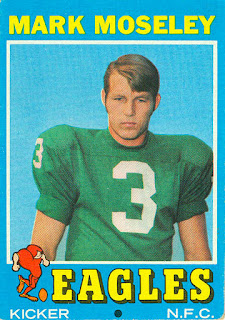
Mark Moseley - Oh, what could have been! Moseley was drafted by the Eagles in 1970, and after a poor rookie season (56% of field goals made) where he was also pressed into service as a punter due to injuries, the Eagles gave up on him. After 2 seasons with the Oilers, Mark went on to kick for the Redskins for 12 years, leading the NFL in field goals 4 times.
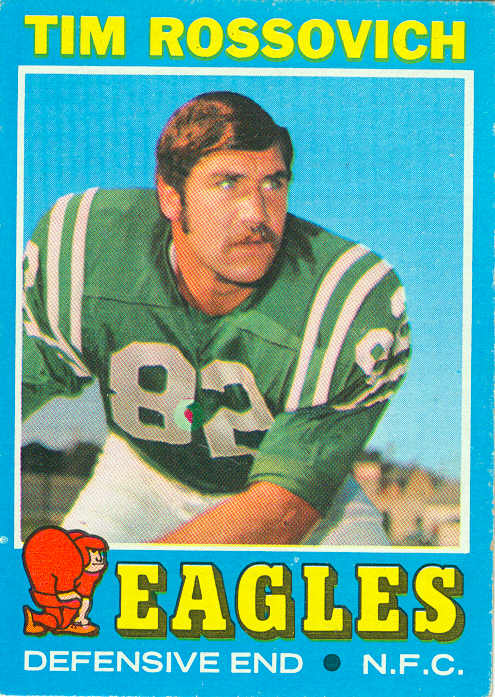
Tim Rossovich - The Eagles' #1 pick in the 1968 draft was probably more notable for his off-field activities (like eating glass and setting his hair on fire) than for his football accomplishments. After starting at left defensive end for 2 1/2 seasons, he moved to middle linebacker midway through the 1970 season, replacing long-time veteran Dave Lloyd. After the 1971 season, he moved on to the Chargers. Rossovich played for the WFL's Philadelphia Bell for the 1974-75 seasons, then returned to the NFL with the Oilers in 1976.
After football, Tim began acting, and appeared in various TV series, including "Magnum, P.I." (with his college roommate Tom Selleck), "MacGyver", "Knight Rider", and most notably 1980's "When the Whistle Blows".
Gary Pettigrew - Gary was the Eagles' #2 draft pick in 1966, and was a starter on their defensive line for 8-plus seasons, except for missing some time in 1969 and 1971 with injuries. He was the team's starting right end for his first 2 seasons, before moving to defensive tackle. He began his last season (1974) with the Eagles, but ended it with the Giants.
Steve Preece - Preece began his career with the Saints in 1969, but was the Eagles' starting free safety in 1970. He replaced long-time Eagles' free safety Joe Scarpati, who was traded to the Saints in a separate deal. After his 2nd season with the Eagles, Steve moved on to the Broncos and Rams before ending his career with the Seahawks in 1977.
Adrian Young - Young was the Eagles' #3 pick in 1968 out of USC, the same school where they found their #1 pick Rossovich. After 2 seasons as a backup, Adrian was a starting outside linebacker in 1970. He missed almost all of 1971 due to injury, and was traded to the Lions early in the 1972 season. He finished his career in 1973 with the Bears.
One more thing: this picture is not Adrian Young - it's Rick Duncan. Duncan punted for 1 game with the Eagles in 1968, and was invited to their 1971 training camp, but didn't make the team. Below are Young's and Duncan's pages from the Eagles 1971 yearbook.


March 2013 edit: A fellow blogger has now corrected Topps' oversight.
Also check out the 1967 and 1972 Eagles.
.
Aside from not including a quarterback, the position allocation seems a little strange here: 3 running backs, 2 wide receivers (including kick returner Billy Walik instead of veteran starter Ben Hawkins), no offensive linemen, and no middle linebacker.
Except for Tom Woodeshick, Harold Jackson, and Tim Rossovich, all of the cards here are the player's rookie card. The 1970 rookies (Lee Bouggess, Walik, Mark Moseley) appear in the team's current jerseys. Others are shown in the late-1960s' Eagles jersey with stripes around the shoulders.
I noticed today that although each player's card back contains a long narrative, most of them go into great detail about the player's college career, with only a sentence about their NFL accomplishments. I guess because it's the early-70s Eagles!
Cyril Pinder - Cyril was the Eagles' #2 pick in 1968, and worked his way up to starting halfback in 1970, leading the team in rushing. However he didn't make the team in 1971 (?!?) and was traded to the Bears. After 2 seasons in Chicago, he ended his career in 1973 with the Cowboys.
Lee Bouggess - The Eagles' #3 pick in the 1970 draft, Bouggess was the team's starting fullback for his first 2 seasons, and was the Eagles' 2nd-leading rusher as a rookie, with 401 yards. After missing the 1972 season with injuries, he returned for 1 final season with the Eagles in 1973, as a backup.
Tom Woodeshick - Tom was drafted by the Eagles in 1963, and after 4 seasons as a backup, he was the starting fullback from 1967-69. Woodeshick made the Pro Bowl in 1968, the year he rushed for 947 yards. He was the 2nd-string fullback behind Bouggess from 1970-71, and wrapped up his career with the Cardinals in 1972.
Harold Jackson - Harold was one of the few stars on the Eagles in 1971. Drafted by the Rams in 1968, he was a starter for the Eagles from 1969-72, and led the NFL in receiving yards in 1969 and 1972. After the 1972 season, he returned to the Rams in the Roman Gabriel trade. Jackson played 5 more seasons for the Rams, and 4 with the Patriots. He finished as a backup with the Vikings (1982) and Seahawks (1983).
Billy Walik - Walik's NFL career consisted of 3 seasons (1970-72) with the Eagles as a kick returner and occasional punt returner. I'm not sure why he has a card, as he never scored on a return, and he rarely lined up as a receiver. (Meanwhile, #2 WR Ben Hawkins had over 30 catches and 4 TDs in 1970, but no card in 1971.)
Mark Moseley - Oh, what could have been! Moseley was drafted by the Eagles in 1970, and after a poor rookie season (56% of field goals made) where he was also pressed into service as a punter due to injuries, the Eagles gave up on him. After 2 seasons with the Oilers, Mark went on to kick for the Redskins for 12 years, leading the NFL in field goals 4 times.
Tim Rossovich - The Eagles' #1 pick in the 1968 draft was probably more notable for his off-field activities (like eating glass and setting his hair on fire) than for his football accomplishments. After starting at left defensive end for 2 1/2 seasons, he moved to middle linebacker midway through the 1970 season, replacing long-time veteran Dave Lloyd. After the 1971 season, he moved on to the Chargers. Rossovich played for the WFL's Philadelphia Bell for the 1974-75 seasons, then returned to the NFL with the Oilers in 1976. After football, Tim began acting, and appeared in various TV series, including "Magnum, P.I." (with his college roommate Tom Selleck), "MacGyver", "Knight Rider", and most notably 1980's "When the Whistle Blows".
Gary Pettigrew - Gary was the Eagles' #2 draft pick in 1966, and was a starter on their defensive line for 8-plus seasons, except for missing some time in 1969 and 1971 with injuries. He was the team's starting right end for his first 2 seasons, before moving to defensive tackle. He began his last season (1974) with the Eagles, but ended it with the Giants.
Steve Preece - Preece began his career with the Saints in 1969, but was the Eagles' starting free safety in 1970. He replaced long-time Eagles' free safety Joe Scarpati, who was traded to the Saints in a separate deal. After his 2nd season with the Eagles, Steve moved on to the Broncos and Rams before ending his career with the Seahawks in 1977.
Adrian Young - Young was the Eagles' #3 pick in 1968 out of USC, the same school where they found their #1 pick Rossovich. After 2 seasons as a backup, Adrian was a starting outside linebacker in 1970. He missed almost all of 1971 due to injury, and was traded to the Lions early in the 1972 season. He finished his career in 1973 with the Bears. One more thing: this picture is not Adrian Young - it's Rick Duncan. Duncan punted for 1 game with the Eagles in 1968, and was invited to their 1971 training camp, but didn't make the team. Below are Young's and Duncan's pages from the Eagles 1971 yearbook.


March 2013 edit: A fellow blogger has now corrected Topps' oversight.
Also check out the 1967 and 1972 Eagles.
.
Subscribe to:
Posts (Atom)